
When literacy results dip, the first move in many schools is to borrow time. Social studies periods get shorter, or they turn into comprehension lessons with a history-flavoured passage. The intention is understandable. The effect is usually the opposite of what the school wants.
Here is why. A reader who already knows something about a topic reads about it more easily. A student who has spent weeks learning how trade routes worked will make sense of a passage about a port city far faster than one who has not. Cut social studies to make room for reading practice, and you may remove the very knowledge that makes reading easier.
Strong social studies and language arts links work in the other direction. They use social studies to build literacy while keeping the subject’s own thinking at the centre.
Social studies texts ask for different reading
A novel and a historical letter both contain words, but students read them in very different ways. Each kind of text in social studies asks for its own reading move, and general language lessons may not teach it. This is the idea behind disciplinary literacy in social studies: every subject has its own ways of reading, writing and arguing, and students need to be taught them.
A historical source, for example, has an author with a purpose. Reading it well means asking who wrote it, when, and why we should trust or doubt it. A map argues through what it includes and leaves out, so students need to read its symbols and scale, then ask what the map wants them to notice and what is missing. A timeline places events in order, but it can trick readers into assuming that one event caused the next. The key question is whether something happened because of an earlier event, or simply after it.
Charts and graphs ask students to read data carefully and draw conclusions that the evidence can actually support. That means asking what the data shows and, just as importantly, what it cannot tell us. Civic debates build a different skill: making a claim, supporting it with evidence and answering a counter-argument. And key vocabulary matters only when students can use a term like “trade” or “government” to explain something, not just define it. Taken together, these moves give students a toolkit that makes them stronger readers across every subject, not just in social studies.
Writing with something worth saying
Social studies also gives students a reason to write. A paragraph explaining why a city grew where it did is real explanatory writing. An argument about how a community should share scarce water is real persuasive writing, with evidence and consequences. Students write better when they have something to say, and social studies supplies that.
It also raises the bar for evidence. A persuasive essay in a language lesson might accept strong feelings as support. A civic argument should not. That difference is worth teaching explicitly.
Design moves for literacy across the curriculum
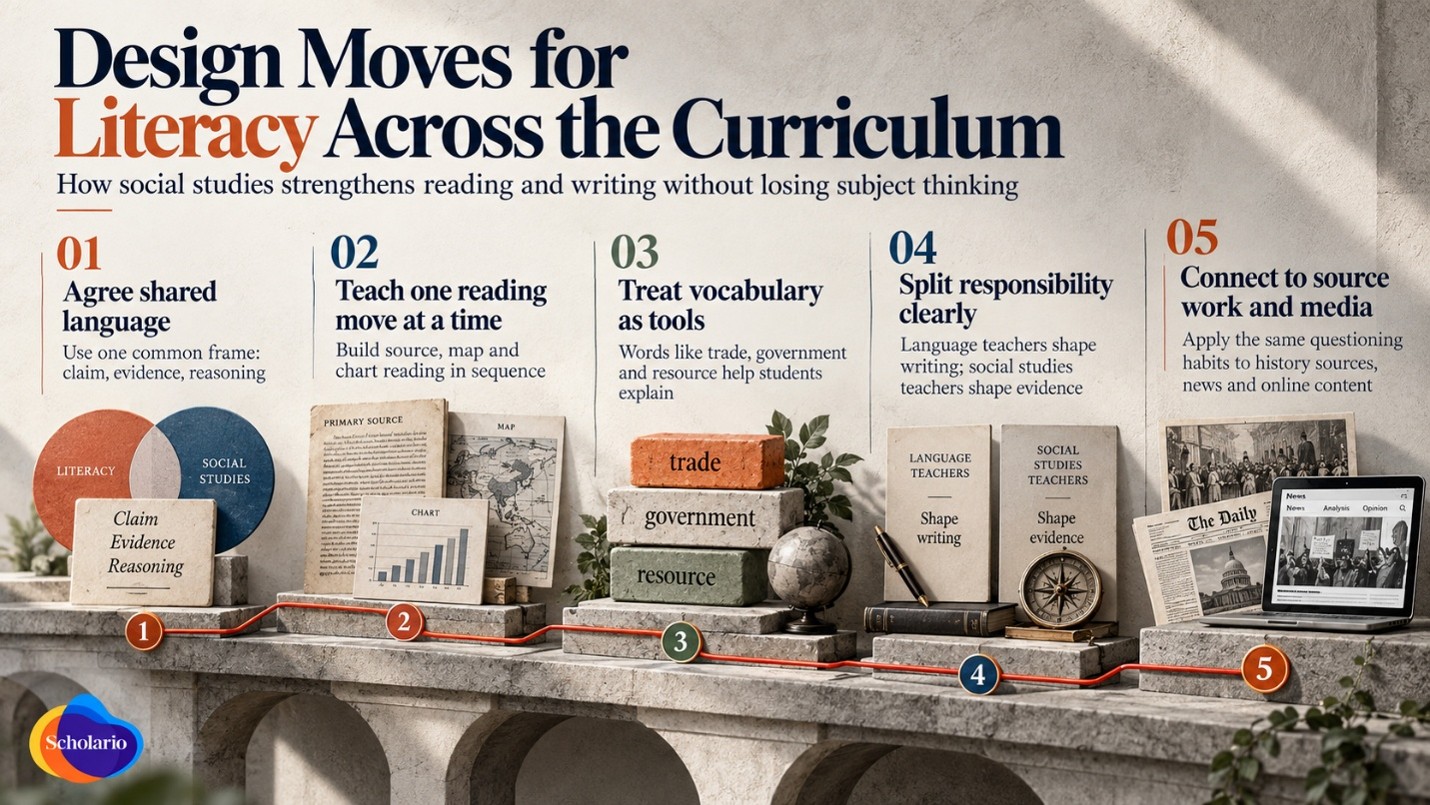
Agree shared language with language teachers. If one teacher says “topic sentence” and another says “claim,” students hear two systems. A shared frame, such as claim, evidence and reasoning, helps students carry skills between rooms. This is one of the most practical ways to build an interdisciplinary social studies curriculum.
Teach one reading move at a time. Students cannot learn to question a source, read a map and analyse a chart all in the same week. Build them in sequence across the year.
Treat vocabulary as tools. Words like “trade,” “government” and “resource” matter because students use them to explain. Definitions alone do not show understanding.
Split the responsibility clearly. The language teacher can own the structure of a paragraph. The social studies teacher owns the standard of evidence. Both matter, and students need to know which teacher is asking for what.
Connect to source work and media. The same reading moves lead naturally into source-based historical inquiry [Blog 35] and into media literacy in the social studies curriculum [Blog 23 ], where students apply the same questions to news and online content.
Here is a question worth raising at the next planning meeting: When a student writes a well-structured paragraph with weak historical evidence, which teacher marks it down, and do both teachers agree on why?
One caution
Literacy should serve the subject, not replace it. If every social studies lesson becomes a reading strategy lesson, students lose the history, geography and civics that make them better readers in the first place. The goal is simple: read like a historian, write like a citizen, and understand more as a result.