
Beyond Recall: Designing Social Studies Assessments That Show How Students Reason
A Grade 8 student scores 18 out of 20 on a unit test about the American Revolution. She knows the dates, the battles and the key names. Then her teacher gives her two short accounts of the Boston Massacre. One comes from a colonial pamphlet and one from a British officer. The teacher asks which account is more trustworthy, and why. She doesn’t know where to start.
Did the test fail her? Not really. It did exactly what it was built to do: check whether she remembered. It was never designed to show whether she could weigh a source, test a claim or explain why two witnesses disagree.
That gap is the central problem in social studies assessment design. Most schools say they want critical thinkers. Most tests still reward memory.
Recall is not the enemy
To be clear, knowledge matters. A student cannot reason about the causes of the Revolution without knowing what happened in 1765 or 1773. Reasoning runs on knowledge.
The problem starts when assessment stops at recall. If every question can be answered by remembering a fact, students learn that social studies is a subject of facts. Teachers, reasonably, teach toward what gets measured.
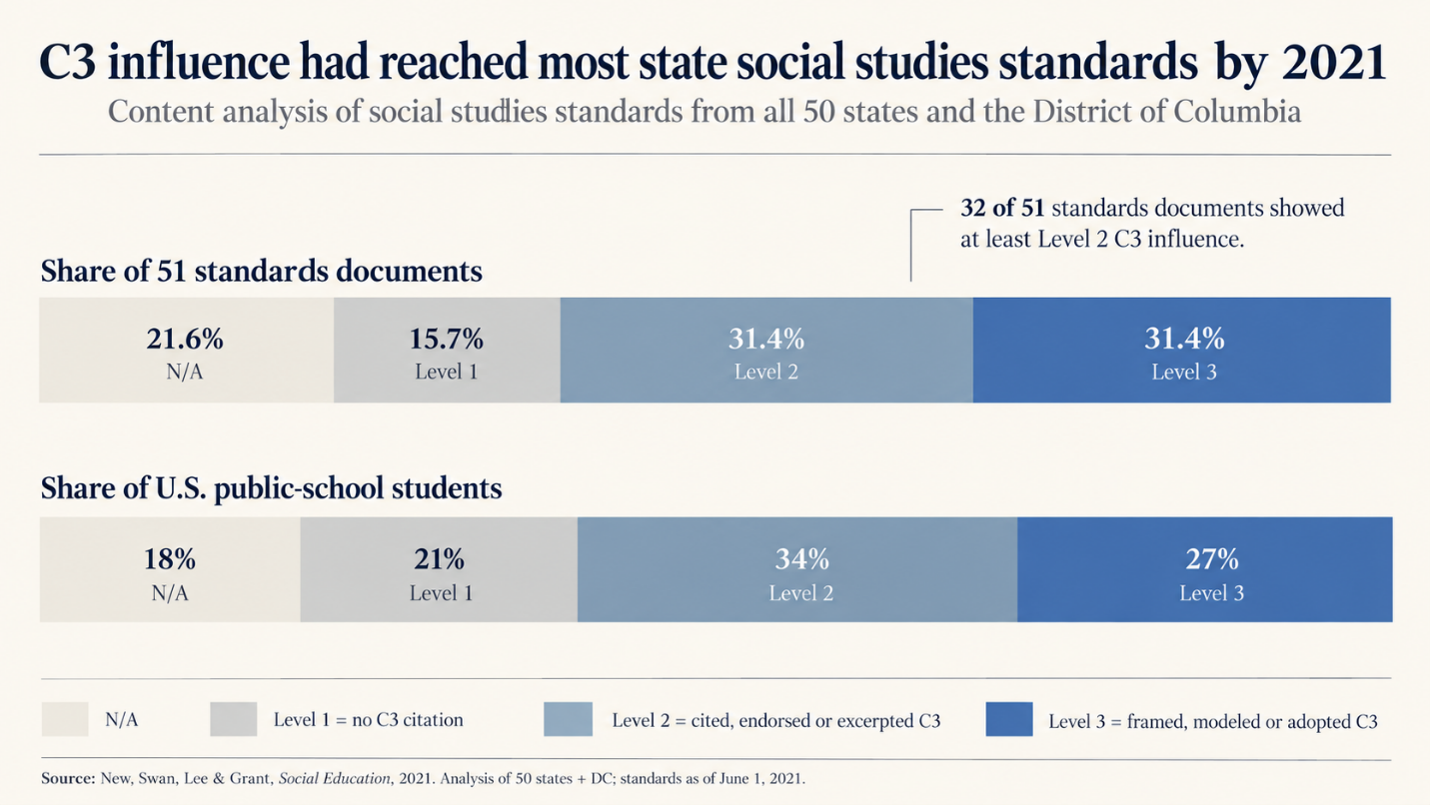
The US C3 Framework makes the wider goal explicit. It organises inquiry around four dimensions: developing questions and planning inquiries, applying disciplinary concepts and tools, evaluating sources and using evidence, and communicating conclusions and taking informed action. The framework has been adopted[35] or adapted into the social studies standards of a majority of US states. So when standards ask for evidence and argument but tests ask only for facts, the test quietly becomes the real curriculum. (socialstudiessocialstudies)
What research says about question format
A Stanford validity study looked at this directly. Researchers ran think-aloud interviews with 26 high school students, comparing short constructed-response History Assessments of Thinking (HATs) with multiple-choice versions of the same tasks. Both formats drew on historical thinking, but the HATs gave a better picture of student proficiency, and the multiple-choice items prompted more reasoning that had nothing to do with the skill being tested. (stanford)
This study needs careful reading. It involved a small group of US high school history students. It does not prove multiple choice is useless. What it does suggest is that the format of a question shapes the thinking students do. If you want to see reasoning, students usually need room to show it.
Four design moves that shift a test toward reasoning
Give students something to reason with. A source, a map, a data table or a short case. Without material, “analyse” questions turn into “remember what the textbook said.” One Stanford task, for example, shows students a 1932 painting that claims to show the 1621 First Thanksgiving. The obvious question, “how useful is this as evidence?”, cannot be answered from memory. (historynewsnetwork)
Ask for a claim, not a label. “Which source is more reliable, and why?” does more work than “Who wrote Source A?”
Ask what the evidence cannot show. Knowing the limits of evidence is often what separates a good answer from a strong one.
Keep it short where you can. Reasoning tasks do not have to be essays. The Stanford team designed tasks that students can finish in under ten minutes, some in under five. A two-sentence response to a well-chosen source can tell a teacher more than ten matching items. stanford
Recall vs reasoning: the same topic, two different tests
| Strand | Recall item | Reasoning item | What the reasoning item reveals |
| History | When was the Declaration of Independence signed? | Two accounts of the Boston Massacre disagree. Which is more useful, and what can’t it tell you? | Sourcing, corroboration, limits of evidence |
| Geography | Name the longest river in Africa. | Using a rainfall map and a population map of Egypt, explain where most people live and why. | Spatial reasoning across two data sets |
| Civics | List the three branches of government. | A city bans protests near hospitals. Which rights are in tension, and how would each side argue? | Weighing rights, taking perspectives |
| Economics | Define scarcity. | A town can fund a park or a bus route, not both. Using the data given, which serves more residents? | Trade-offs, evidence-based decisions |
Reasoning should grow across grades
The claim–evidence–limitation pattern works at every grade, but the demand should rise. In Grade 2, a student looks at two pictures and says which shows “long ago” and names one clue. In Grade 5, the student explains a cause and effect using two pieces of evidence. By Grade 8, the student weighs sources that disagree and answers a counterargument. This is what vertical progression in Social Science looks like in assessment: a skill that appears every year should get harder, not just come back.
If your end-of-unit test could be passed by a student who never looked closely at a single source, what is the unit actually teaching?
What curriculum leaders can do next
Start with an audit. Take one existing unit test and tag each item as recall, apply or reason. The balance is usually clear within minutes. Next, build a small bank of source-based tasks for each unit and use them formatively first, so teachers see student thinking before the unit ends. Finally, make sure your scoring matches your intent. A reasoning task scored for length or neatness teaches the wrong lesson. That is why reasoning tasks need a social studies project rubric built around disciplinary reasoning[6], and why the strongest tasks begin with questions that connect disciplines[10]. For history specifically, see our guide to working with historical sources.
The bottom line
Recall tells you what students have stored. Reasoning tasks tell you what they can do with it. A good social studies assessment needs both. Most schools currently need much more of the second.