
Daily Checks That Reveal Students’ Social Studies Understanding: Small Questions That Show How Students Think

The lesson ends and the teacher asks, “Any questions?” Nobody speaks. Or the teacher asks for a thumbs up, and thirty thumbs go up.
Both moments feel like evidence, but neither is. Silence can mean understanding, confusion, or a wish to get to break. Thumbs tell you how confident students feel, and confident students are sometimes confidently wrong.
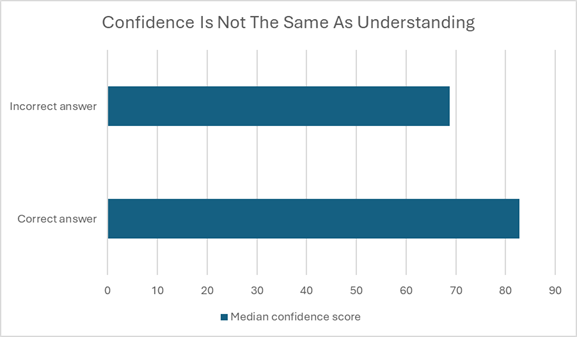
SOURCE: Foster, Woodhead, Barton et al., Educational Studies in Mathematics, 2022.
In Social Studies this matters more than it seems. Many misconceptions sound reasonable. Examples include “a map shows the world exactly as it is” and “rich countries are rich because they work harder”. Another is “people in the past were less intelligent because they didn’t have technology”. If these ideas go unnoticed for a week, they become the foundation for the next unit.
What makes a daily check worth doing
A daily check for understanding earns its place when it passes four tests.
- It targets the lesson’s one key idea, not a random detail. If the objective was to explain why early settlements grew near rivers, don’t check the name of a river.
- It can expose a misconception. A question that almost everyone gets right tells you little.
- It can be read quickly. If reading the responses takes an hour, it won’t happen daily.
- It changes tomorrow. If the results never affect the next lesson, it is paperwork, not assessment.
If a daily check never changes what happens in tomorrow’s lesson, is it assessment, or just a routine?
Daily check formats that work in Social Studies
One-sentence “because.” Students finish a sentence such as “Early cities often grew near rivers because…” It takes about two minutes. It shows whether students can link a cause to an effect, or only name a fact.
Because / but / so. Students extend one idea in three directions. For example: “Trade grew along the coast because… but… so…” This takes around four minutes. It shows depth, because students must give a reason, a complication and a consequence.
Diagnostic multiple choice. This is a single question where each wrong answer matches a common misconception. It takes about a minute. It shows not just who is wrong, but why they are wrong. An example follows in the next section.
Odd one out. Students get a short list, such as “tax, law, election, mountain,” and explain which item doesn’t belong. It takes about two minutes. It shows whether students understand where a concept’s boundaries are.
Mark and explain. Students mark a place on a blank map and give one reason. For example: “Mark where you would build a port, and say why.” It takes about three minutes. It checks spatial reasoning, not just whether students can recall where places are.
Spot the error. Students get a flawed claim to fix, such as “The Industrial Revolution happened because people wanted factories.” It takes about three minutes. It shows whether students can evaluate an idea, not just repeat one.
Before and after. Students complete “At the start I thought… Now I think… because…” It takes about three minutes. It shows how their thinking changed during the lesson.
Sort it. Students sort six cards into two groups, such as needs and wants, or physical and human features. Then they write one sentence explaining the rule they used. It takes about four minutes. It shows whether they understand the categories or are just guessing.
None of these checks need technology. Mini whiteboards, scrap paper and exit slips work fine. Most formats also work orally, which matters for younger students and for those still building their written language.
Wrong answers should tell you something
The most underused daily check is the well-built multiple-choice question. Its value lies in the wrong options, not the right one.
Why did many early cities grow near rivers?
- A. Rivers provided water, fertile soil and transport routes. (secure understanding)
- B. People liked living near beautiful views. (modern thinking projected onto the past)
- C. Rivers were the only places people knew about. (assumes people in the past were limited or less capable)
- D. Governments ordered people to live there. (assumes modern state structures existed)
Each wrong answer points to a specific gap. If a third of the class picks D, the teacher knows exactly what to address tomorrow. A question with random wrong options only tells you who got it right.
Writing questions like this takes time. It is exactly the kind of work that should be shared across a department, or built into curriculum materials, rather than reinvented by each teacher every evening.
What to do with the evidence
A simple routine keeps daily checks manageable. Sort responses into three piles: got it, partly there, and misconception. That takes a few minutes for a class set of one-sentence answers.
Then let the piles shape the next lesson’s opening. For example, you might read out two anonymous responses and ask the class which is stronger. You might re-teach the idea to a small group, or start with a quick question aimed at the most common error.
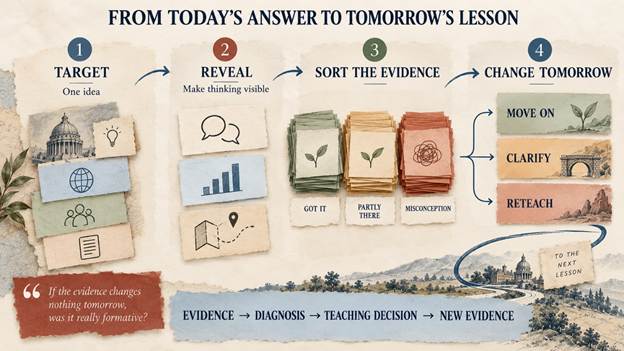
Keep daily checks low-stakes. Once they carry marks, students start guessing what the teacher wants instead of showing what they think. The whole point is to see their real thinking.
How checks change across grade levels
With younger learners, daily checks are mostly spoken or visual: pointing to a place on a map, sorting pictures, or finishing a sentence out loud. In the middle grades, short written “because” sentences and simple mapping tasks work well. Older students can handle spot the error and because / but / so, which ask them to evaluate as well as explain.
The design principle doesn’t change: check the thinking, not just the fact. That is also the difference between assessing what students can explain rather than what they can recall, which applies to every kind of assessment, not only daily checks. For civics lessons, the same thinking extends to scenario-based questions, discussed in how schools should assess civic knowledge and skills.
Conclusion
A good daily check is small, quick and targeted. It asks one question about the lesson’s key idea, designed so that a wrong answer tells you why it is wrong. When schools treat these checks as information for tomorrow’s teaching, rather than as marks to record, they catch misconceptions while they are still easy to fix.
Where KODEIT Fits
In Scholario Social Science, each day in the pacing guide carries an observation question, so teachers can see how learning is going before a unit ends. Every lesson closes with reflection and an assessment step tied to its stated objectives, and question banks accompany each lesson. The design follows the idea explored here: a daily check is most useful when it is planned together with the objective, not added at the end.