
How Should Schools Assess Civic Knowledge and Skills? Why Naming the Branches of Government Is Only Half the Test
A Grade 8 student can tell you that a legislature makes laws, an executive carries them out, and courts interpret them. Now give the same student a short scenario. The local council wants to turn a park into a car park, and residents are divided. Ask what should happen next and who should have a say.
Many students stall. They know the structure. They don’t know how to use it.
That gap sits at the centre of civic education assessment. Civic knowledge is easy to test, and civic skill is harder. So most schools test the first and quietly assume the second will follow.
Two strands, not one
Civic learning has at least two strands, and they need different kinds of assessment.
Civic knowledge covers how decisions are made, who holds which responsibilities, what rights and duties mean, and how rules and laws come about.
Civic skills are what students do with that knowledge. That includes weighing competing interests, checking a claim before accepting it, and explaining how one decision affects different groups. It also includes listening to a view they disagree with and proposing a sensible course of action.
A third layer, civic dispositions, sits underneath both. This means respect, fairness and willingness to take part. It matters a great deal, but it also needs the most care in assessment, as we’ll see below.
Testing knowledge is not the mistake. Knowledge is the raw material of civic reasoning. A student who doesn’t understand what a council does cannot reason about one. The mistake is stopping at knowledge.
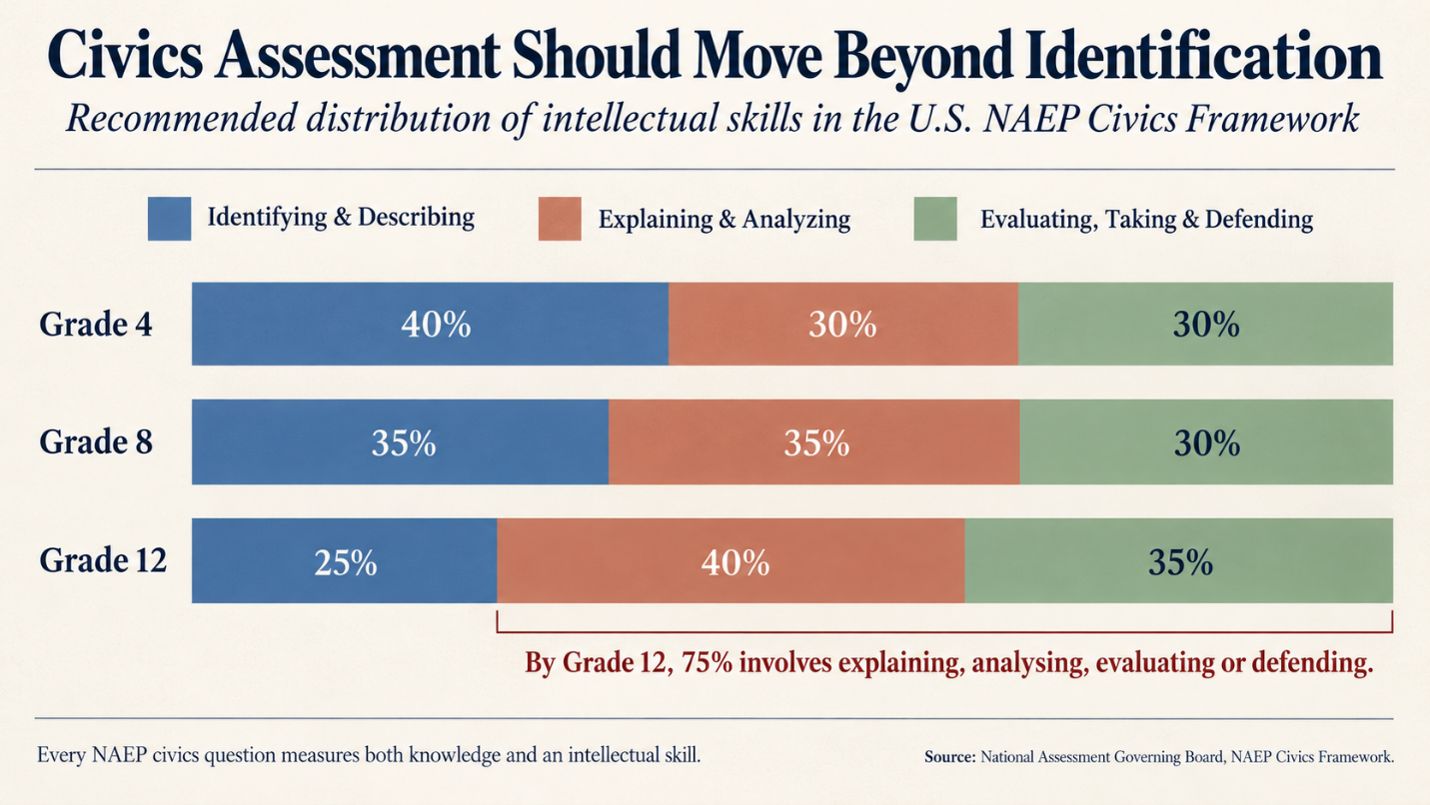
What stronger civic assessment looks like
| Civic strand | What you want to see | Weak assessment | Stronger assessment |
| Institutions | Understands roles and how they connect | “Name the three branches of government.” | “A new law is passed that some people think is unfair. Trace what could happen next and who would be involved.” |
| Rights and responsibilities | Sees that rights have limits and come with duties | “List three rights of a citizen.” | “A family celebration is loud late at night and a neighbour needs rest. Whose rights are involved, and how should the community decide?” |
| Evaluating information | Checks claims before accepting them | “What is a fact?” | “Here are two short statements about a planned road. Which is more trustworthy, and why?” |
| Perspective-taking | Explains how one decision affects different people | “Why should we respect others?” | “How does a new school rule on phones affect students, parents and teachers differently?” |
| Decision-making | Makes a reasoned case and handles an objection | “What is voting?” | “Your class can fund one project with a limited budget. Make a case for one, then answer the strongest objection.” |
| Participation | Knows realistic, responsible ways to take part | “Why should people help their community?” | “Plan one step a student group could take about litter near the school. Who would you need to involve?” |
Notice that the stronger tasks still need knowledge. You cannot trace what happens after a law is passed without knowing the institutions involved. The scenario forces students to use what they know, which is where understanding becomes visible.
Assess the reasoning, never the opinion
This is where civics differs from most subjects, and where civic assessment most often goes wrong.
Civic questions rarely have one correct answer. Should a town fund a new library or repair its roads? Reasonable people disagree. If the marking scheme rewards one conclusion, the assessment stops measuring civic reasoning. It starts measuring whether students can guess what the teacher thinks.
The fix is to mark the quality of the thinking. Did the student identify who is affected? Did they use relevant knowledge? Did they recognise a trade-off and deal with the strongest objection? Under this approach, two students can reach opposite conclusions and both score highly.
The same principle works in systems where national identity and shared values are an explicit part of the curriculum. Schools can teach respect for institutions and national belonging openly. They can then assess how well students explain and apply those ideas, rather than asking for statements of agreement. Explaining why a community rule exists, and how it balances individual and shared interests, is harder than agreeing with it. It also says far more about what the student has learned.
Dispositions are best observed over time and described, not scored. A teacher can note that a student listens, builds on others’ points and changes their mind when given a good reason. Putting a mark on “respect” in a written test usually rewards students who know the right words to say.
If every student in a class reaches the same “correct” conclusion on a civic question, has the assessment measured reasoning, or compliance?
How civic assessment should change across grades
In the early grades, civic learning is about rules at home, at school and in the community, and the people who help us. Assessment works best through talk, role-play and drawing. For example: “What would happen on the playground if there were no rules?”
By the upper primary years, students can handle simple scenarios about how decisions are made and who is affected. Short written explanations and sorting tasks suit this stage. In lower secondary, structured debate and written argument become realistic, provided teachers mark them against clear criteria. In upper secondary, students can analyse an actual policy, evaluate the sources behind it and write a sustained argument.
The skill stays the same across all these stages: reasoning about how people live together and make decisions. What grows is the complexity of the situation and how independently students handle it. This is what vertical progression in Social Science should look like in civics.
Practical design principles for curriculum leaders
Start from a situation, not a definition. A civic scenario that students can recognise, such as a park, a school rule or a shared budget, tells you more than a definition.
Mix formats deliberately. Quick knowledge checks still have a place. Pair them with scenario questions and observed discussion. Each format shows you something the others miss.
Make discussion assessable. Give teachers three or four short criteria to use during a debate. For example: uses evidence, responds to what others actually said, and acknowledges a good counter-point. A ready-to-adapt rubric for inquiry projects can be trimmed for this purpose.
Anchor scenarios in taught content. If a task can be answered with general opinion alone, it is testing debating confidence, not civic learning. The same logic sits behind assessing what students can explain, not just what they can recall.
Plan it at the curriculum level. Civic reasoning grows slowly. Leaders should decide where scenario-based tasks appear across grades, instead of leaving it to individual teachers.
Conclusion
A civics test that only checks names and definitions tells you whether students have studied. A civics assessment that asks them to reason through a real situation tells you whether they are learning to be citizens. The second is harder to design and harder to mark. It is also the only one that measures what civic education is for.
Where KODEIT Fits
Scholario Social Science teaches social and national values through everyday contexts in the early grades and ties them to citizenship later. Its assessment changes with the stage. Oral discussion and role-play come in Grades 1–3, and debate and structured argument in Grades 7–8. Projects such as analysing a national policy are designed to assess application rather than recall. That progression reflects the principle behind this article: civic knowledge matters most when students can reason with it.