Integration Starts With the Question: Designing Social Studies Around Questions That Connect Disciplines
Many schools teach an Ancient Egypt unit that looks integrated. On Monday, students label the Nile on a map. On Wednesday, they learn about pharaohs. On Friday, they complete a worksheet on trade. Three disciplines share one topic, and the planning document calls it interdisciplinary.
For students, though, it is three separate lessons that happen to share a name. Nothing in the unit needs geography to explain the history, or economics to explain the politics.
This is the most common gap in interdisciplinary social studies.
A shared topic collects content. Only a shared question connects it.
A simple test for real integration
Take your unit’s main question and remove one discipline. Does the answer get weaker? If students could answer just as well without the geography, the geography was decoration.
“What was life like in ancient Egypt?” passes no such test. Students can answer it with a list. “Was the Nile a gift, or did the Egyptians make it one?” is different. Students cannot answer it well without geography (what the flood did), economics (what surplus made possible) and history and civics (how control of water and grain created power).
What the Inquiry Design Model offers
The Inquiry Design Model (IDM), built by the lead authors of the C3 Framework, gives this idea a clear structure. In IDM, compelling questions deal with issues found within and across the social studies disciplines. Supporting questions are narrower. They focus on descriptions, definitions and processes the disciplines broadly agree on, and there are usually three or four of them to scaffold the main question. The whole inquiry fits on a one-page blueprint showing its questions, tasks and sources. (ocmbocesc3teachers)
This is where integration gets its structure. Each supporting question can be anchored in one discipline, so each discipline keeps its own way of thinking while serving the same argument:
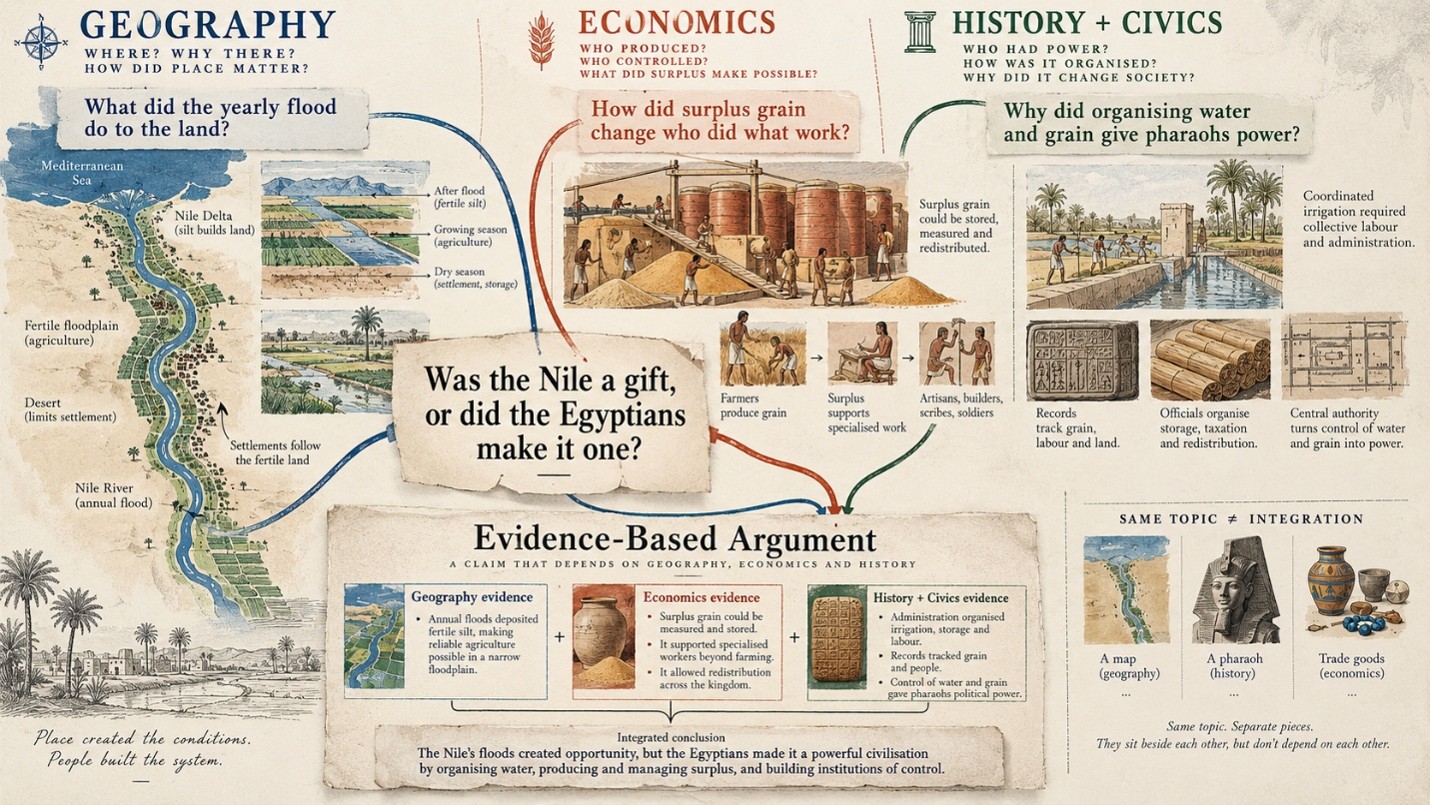
- Compelling question: Was the Nile a gift, or did the Egyptians make it one?
- Supporting question 1 (Geography): What did the yearly flood do to the land?
- Supporting question 2 (Economics): How did surplus grain change who did what work?
- Supporting question 3 (History/Civics): Why did organising water and grain give pharaohs power?
- Final task: An argument that needs all three.
This is not easy work. Participants in C3 Teachers’ own design institute found that writing the compelling and supporting questions, though it looks simple, may be the hardest part of the process. (c3teachers)
From topic to connecting question
| Topic | Topic-style question | Connecting question | Disciplines the answer needs |
| Local community (Gr 2–3) | What jobs do people do in our town? | Why are the shops in our town where they are? | Geography, economics |
| Ancient Egypt (Gr 4–6) | What was life like in ancient Egypt? | Was the Nile a gift, or did the Egyptians make it one? | Geography, economics, history, civics |
| Silk Road (Gr 6–7) | What goods travelled on the Silk Road? | Who gained most from the Silk Road, and who paid the price? | History, economics, geography |
| Industrial Revolution (Gr 8–9) | What were the main inventions? | Was industrialisation worth what it cost workers and cities? | History, economics, geography, civics |
| Water (Gr 7–10) | Where does our water come from? | Who should decide how a shared river is used? | Geography, civics, economics |
What makes a connecting question work
It is genuinely open. Evidence should be able to support more than one answer. “Why is pollution bad?” has one acceptable answer, so it is a message, not a question.
Sources exist for each discipline. A question is only useful if students can investigate it. If you can’t find a grade-appropriate map, data set or source for each supporting question, the question needs to change. See designing inquiry questions students can actually investigate[32].
It fits the grade. Younger students need questions tied to places they know. Older students can handle distant places, longer time spans and real value conflicts.
It ends in an argument that needs the disciplines. If the final task can be completed with one discipline, the integration stops before the end.
Each discipline keeps its own voice. Integration should not turn everything into general “topic knowledge.” Geography should still ask where and why there. History should still ask what changed and why.
If you removed the geography lessons from your integrated unit, would students’ final arguments change at all?
Implications for curriculum design
For curriculum teams, this changes the planning order. Instead of choosing a topic and sharing it out among subjects, start by writing the question[8], test whether it needs more than one discipline, and only then plan lessons[9]. Assessment should follow the same logic. The final argument task should be scored with criteria for each discipline involved, as described in building a project rubric around disciplinary reasoning. For the wider idea of what integration means, see what integration actually means.
The bottom line
Integration is not about putting history, geography and civics on the same page. It is about asking a question that needs all of them. Get the question right, and the connections become something students actually use.
Where KODEIT Fits
In Scholario Social Science, lessons open with a question students investigate rather than an answer they copy, and units are built by backward design. In Grades 7–8, a thinking prompt called Crossroads of Knowledge asks students to connect history with science, technology and economics. Unit projects bring the four strands together in one piece of work. The approach reflects the view in this article: integration should come from what students are asked to figure out, not only from how topics are arranged.