
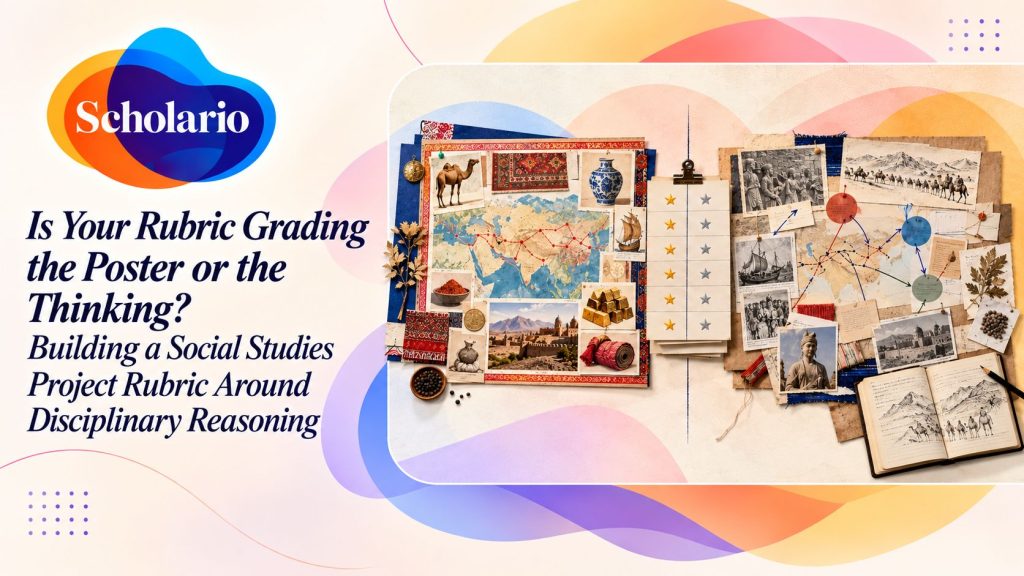
A Grade 6 class finishes a project on the Silk Road. The rubric has five criteria, each worth five points: Creativity, Neatness, Presentation, Research and Teamwork.
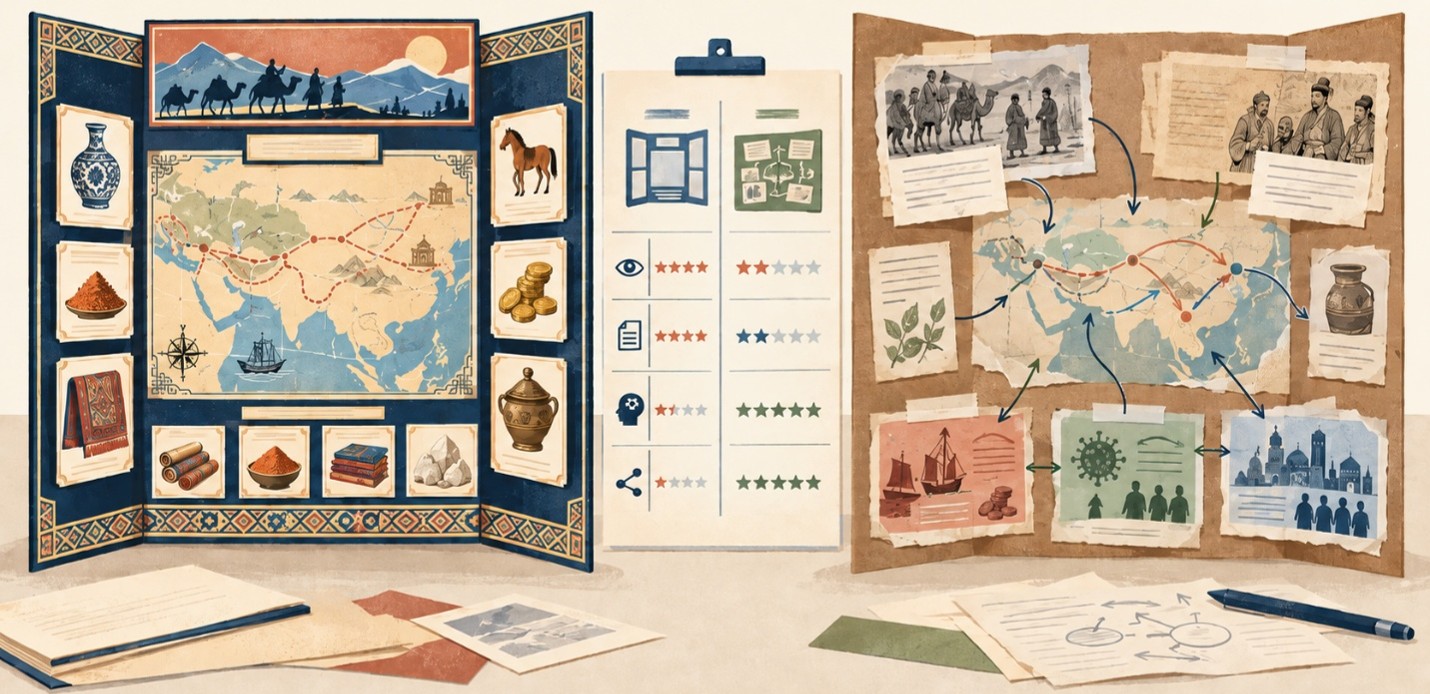
The best-looking poster scores 23 out of 25. It has a hand-drawn map, bright images and a neat list of goods that were traded. Nowhere does it explain why the route mattered or who gained from it. Another group’s rougher poster argues that the Silk Road spread disease as well as silk, and uses two sources to show it. It scores 17.
The rubric worked exactly as written. It told everyone what mattered, and what mattered was not reasoning.
What a rubric really teaches
Students treat a rubric as the rules of the game. Teachers do too, when they plan the next project. So the criteria matter more than the scoring scale.
Research supports rubrics, with an important condition. A widely cited review by Jonsson and Svingby analysed 75 studies and found that rubrics can make scoring more reliable when they are analytic, topic-specific and backed by exemplars or rater training. Evidence that rubrics improve learning was less clear. The studies they reviewed had varying results, and the most consistent benefit users reported was clearer expectations. (arxivnii)
Our reading of this is simple: clear expectations only help if they point at the right thing. A rubric can be very reliable at measuring neatness. Other researchers have warned that rubrics do not guarantee effective assessment, and one study suggested they may trade validity for reliability. (umass)
What “disciplinary reasoning” means
Each social studies discipline has its own way of thinking. History asks about sources, context, cause and consequence, and change over time. Geography asks about place, pattern, scale and how people and environments shape each other. Civics asks about rights, authority, competing views and fair decisions. Economics asks about scarcity, choices, costs, benefits and incentives.
A strong project rubric turns these ways of thinking into criteria.
| Generic criterion | Replace with | Strand | What strong work looks like |
| Research | Use of evidence | All | Chooses evidence that supports the claim and explains why it can be trusted |
| Content accuracy | Historical explanation | History | Explains causes and consequences, not just events in order |
| Creativity | Spatial reasoning | Geography | Uses a map or data to explain a pattern, not to decorate |
| Presentation | Weighing perspectives | Civics | States two or more views fairly, then judges between them |
| Effort | Reasoning about trade-offs | Economics | Names what is gained and what is given up by a choice |
Presentation and teamwork can stay in the rubric. They should carry less weight, or be reported separately from the academic score.
Six principles for building the rubric
Start from the project question. Ask what reasoning the question demands, and make those your criteria. A project on “Who gained most from the Silk Road?” needs evidence, economic reasoning and perspective. It does not need “creativity” as a main criterion.
Use fewer, sharper criteria. Three to five criteria are usually enough. Long rubrics spread the weight so thinly that no single criterion shapes the work.
Describe quality, not quantity. “Uses three sources” rewards counting. “Explains why two sources disagree” rewards thinking.
Keep the disciplines visible in interdisciplinary projects. A single vague “integration” criterion is hard to score. It works better to include one criterion for each discipline the question actually needs. This connects to how you frame the project in the first place; see designing social studies around questions that connect disciplines.
Calibrate with real work. Before marking, teachers score three sample projects together and discuss where they differ. This is the “exemplars and rater training” condition from the research, made practical.
Give students their own version. Rewrite the criteria in student language and share it at the start, not after grading.
Here is one criterion written across four levels:
| Criterion | Beginning | Developing | Secure | Advanced |
| Use of evidence | States an opinion with no evidence | Lists facts about the topic but doesn’t link them to the claim | Uses relevant evidence to support the claim | Uses evidence from more than one source, explains why it is reliable and notes what it cannot show |
If you removed every presentation criterion from your rubric, would the strongest thinkers still earn the highest marks?
Why this matters beyond one project
Rubrics add up. Across a year, the criteria a department uses send a steady message about what social studies is for. If most points go to appearance and effort, students learn that projects are craft activities. If most points go to evidence and reasoning, students learn that projects are arguments. The same logic applies to short tasks, as discussed in assessments that measure reasoning, not just recall, and to project-based learning that goes beyond the poster.
The bottom line
A project is only as rigorous as the rubric used to judge it. Build the rubric around how historians, geographers, citizens and economists reason, and students will start doing the same.