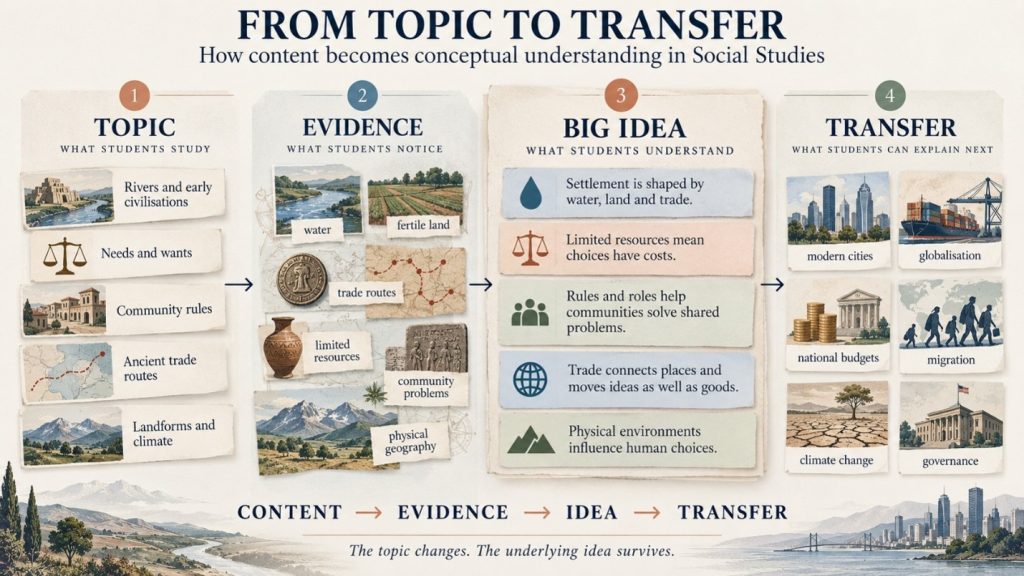
Take a few familiar topics and ask what idea each one could carry. “Needs and wants” is usually taught as a sorting exercise, but it can carry a much bigger idea: resources are limited, so every choice has a cost. That same idea returns when students learn about saving and charity, then national budgets, and later the management of natural resources. “Rivers and early civilisations” can teach students that settlement follows water, fertile land and access to trade, an idea that helps them later explain urbanisation, migration and modern city planning. “Community rules and helpers” can show that rules and roles exist to solve shared problems and can be improved, which becomes the foundation for understanding how laws are made and how systems of governance work.
The pattern continues in the upper grades. Ancient trade routes can teach that trade connects distant places and moves ideas as well as goods, which prepares students to understand globalisation and the modern global economy. Landforms and climate can show that physical processes create patterns that shape human choices, an idea that becomes essential when students study climate change and sustainable development. In each case, the topic does not disappear. Students still learn about rivers, markets and trade routes. What changes is the reason the topic is there: it becomes evidence for an idea students will meet again and understand more deeply each time.
Design moves that make concepts work
Choose fewer ideas and keep them. A curriculum with forty “key concepts” does not have concepts. It has a glossary. A small set per strand, revisited on purpose, is far more powerful.
Write ideas as sentences. Teachers can teach toward a sentence. They cannot teach toward a single word.
Plan the return. A big idea should come back several times across the grades, and each return should demand more: more cases, more complexity, more exceptions. This is the heart of social studies curriculum progression social studies curriculum progression. Repetition is not progression. Deepening is.
Let questions carry the concept. A good compelling question gives students a reason to need the idea. Social studies curriculum design social studies curriculum design built around questions keeps concepts from turning into slogans pinned on the wall.
Assess transfer, not recall. Give students an unfamiliar case and ask them to apply the idea. If they can only repeat the example from the textbook, the concept has not landed yet.
Two traps to avoid
The first trap is over-abstraction with young children. Early-grade learners need concrete, familiar content: their family, their street, their school. The big idea is the thread running underneath, not the lesson title. A six-year-old sorting needs from wants is already working with scarcity. They do not need the word.
The second trap is content-light “skills” units. Some schools respond to “concepts over content” by building lessons about thinking skills with nothing to think about. Concepts need rich content to live in. Without it, students have nothing to reason with.
Here is a question worth putting to any curriculum team:
If a student forgot every date and name from this year but kept the big ideas, would they understand the news better than they did in September?
If the honest answer is no, the curriculum has content but no concepts.
Pulling it together
A concept-led curriculum still teaches pharaohs, rivers and trade routes. It simply knows why. When each topic is chosen as evidence for an idea that will return and deepen, the whole social studies curriculum design framework K-12 social studies curriculum framework starts to hold together.